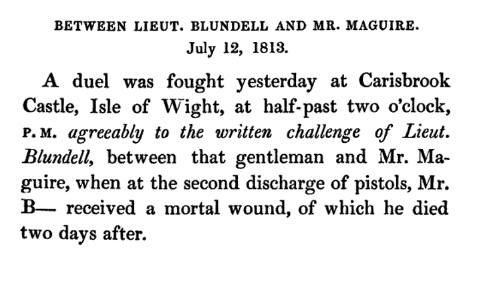
Lieutenant Blundell of the 101st Regiment and EnsignMcGuire of the 6th West India Regiment had fallen out over a rumour. It was alleged that Blundell had spread word that he provided clothing to McGuire — a claim McGuire took as an insult.
Their exchanges grew heated, and it soon became clear a duel might follow. A concerned magistrate intervened, attempting to prevent violence. McGuire gave his word he would not initiate a challenge, but refused to promise he wouldn’t accept one. Blundell, in turn, said he wouldn’t fight within the magistrate’s district — a loophole they exploited.
The duel took place just beyond the jurisdiction, in the moat behind the bowling green at Carisbrooke Castle. Blundell, recently married, was shot through the lung and spine. He was taken to the Wheatsheaf Hotel and nursed in Room 12 by his bride, Jane. He died soon after.
On his deathbed, Blundell confided to a fellow officer that he would have reconciled with McGuire if not for pressure from others. Officers had visited him repeatedly, insisting his honour demanded he fight — warning that refusal would mean disgrace. Two of them, Mr O’Brien and Mr Dillon, even served as his seconds.
Following Blundell’s death, McGuire, O'Brien, Dillon, and a fourth officer, Mr Gilchrist, were charged with murder and condemned to hang. However, all were later pardoned.
The Commander-in-Chief judged that McGuire and Blundell were the least at fault — caught in a code of honour they felt unable to escape. The greater blame lay with those who encouraged the duel. As punishment, Dillon,O’Brien, and Gilchrist were dismissed from His Majesty’s service, with Dillon declared permanently unfit to serve again.