Christabella Harriet Millgate (1899–1974)
Christabella Harriet Millgate was born on the 1st of March 1899 in Newport, the elder daughter of John Curtis Millgate, Architect and Surveyor, and Grace Millgate (née King). The family lived at 89 Castle Road, a comfortable middle‑class home close to the town centre.
Grace Millgate died in 1903, leaving Christabella, aged four, and her younger sister Arabella to be raised largely by their father, supported by extended family. This early loss shaped the domestic life of the household and later influenced Christabella’s unusual civic role.
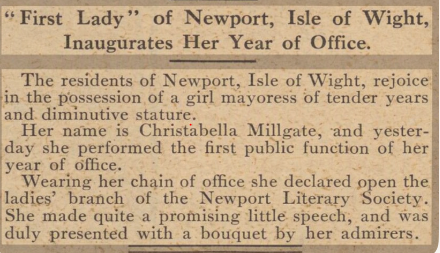
In 1911, John Curtis Millgate became Mayor of Newport. Following Edwardian custom, a widowed mayor’s duties were supported by the nearest suitable female relative. At just twelve years old, Christabella stepped into the role of Mayoress, becoming the youngest Mayoress in England.
To mark the Coronation of King George V, Newport had recently been presented with a new ceremonial Mayoress’s Chain. It was first worn by Mrs F. Templeman during the Coronation year and passed to Christabella for the 1911–12 term. Newspapers across Britain reported on the remarkable sight of a child wearing the newly commissioned chain.
Christabella carried out her duties with charm and confidence. Her first official engagement was opening the ladies’ branch of the Newport Literary Society, where she impressed attendees and was presented with a bouquet. In January 1912, she attended a New Year tea for the aged poor, followed by a church service, where her presence was warmly appreciated.
At the end of her term, Christabella was presented with a gold triple‑chain bracelet bearing the Borough Arms, given by members of the Corporation as a souvenir of her father’s mayoralty. The presentation was made by the new Mayor, Frank Ernest Whitcher, a well‑known gentleman’s tailor and outfitter, a standard civic practice when mayoral office changed hands.
During the First World War, Christabella continued her public involvement. She joined the British Red Cross Society, assisting with fundraising and providing comforts for troops.
In 1915, she and several schoolgirls voluntarily gave up their school prizes and the annual prize‑winners’ party so the money could be used for charity. Their combined funds purchased an invalid chair (wheelchair) for wounded soldiers at Gatcombe House Red Cross Hospital, an act widely praised in the press.
Christabella actually served as Mayoress on three separate terms firstly in 1911, in 1916 during WW1 and in 1926 when her father held office again.